
England recorded 24,470 construction apprenticeship starts and 12,980 achievements in 2024/25. The official achievement rate was 58.3%. Together, these figures describe recruitment into training, qualifications achieved during the year and outcomes for the official reporting cohort. They measure different things. [1]; qualification achievement rates [2].
This page brings together the latest published construction apprenticeship statistics available on 11 November 2026. The main annual comparisons use final 2024/25 data. The latest update covers August 2025 to April 2026 and remains provisional. All figures refer to England’s apprenticeship system; they are not a UK total. [1]
In this article
- About these figures
- Construction apprenticeship statistics at a glance
- How many construction apprenticeships start each year?
- Which construction apprenticeship standards have the most starts?
- How old are construction apprentices, and which levels do they study?
- What is the construction apprenticeship achievement rate?
- Where are construction apprenticeship starts concentrated?
- Apprenticeships in site supervision and management
- What counts as a construction apprenticeship?
- Frequently asked questions
- Sources and methodology
- Download the data
Construction apprenticeship statistics at a glance
- 24,470 starts in the construction subject area in 2024/25.
- 12,980 achievements and 65,320 enrolments during that academic year.
- 12,030 starts were by under-19s, approximately 49.2% of the total.
- 58.3% was the official construction apprenticeship achievement rate, compared with 65.4% across all apprenticeship subjects.
- 23,900 starts were recorded in the provisional August 2025–April 2026 period, up 5.0% on the equivalent previous-year snapshot.
Sources: subject and age data [1], achievement-rate data [2] and latest provisional release [1]. The under-19 share is calculated from rounded published counts.
How many construction apprenticeships start each year?
Construction starts have stayed close to the same level across the latest three academic years with final published data: 24,470 in 2022/23, 24,340 in 2023/24 and 24,470 in 2024/25. The latest annual increase was 130 starts, or approximately 0.5%. The highest total in the five-year series below was 26,470 in 2021/22. [1]
Scroll horizontally to view the full chart on a small screen.
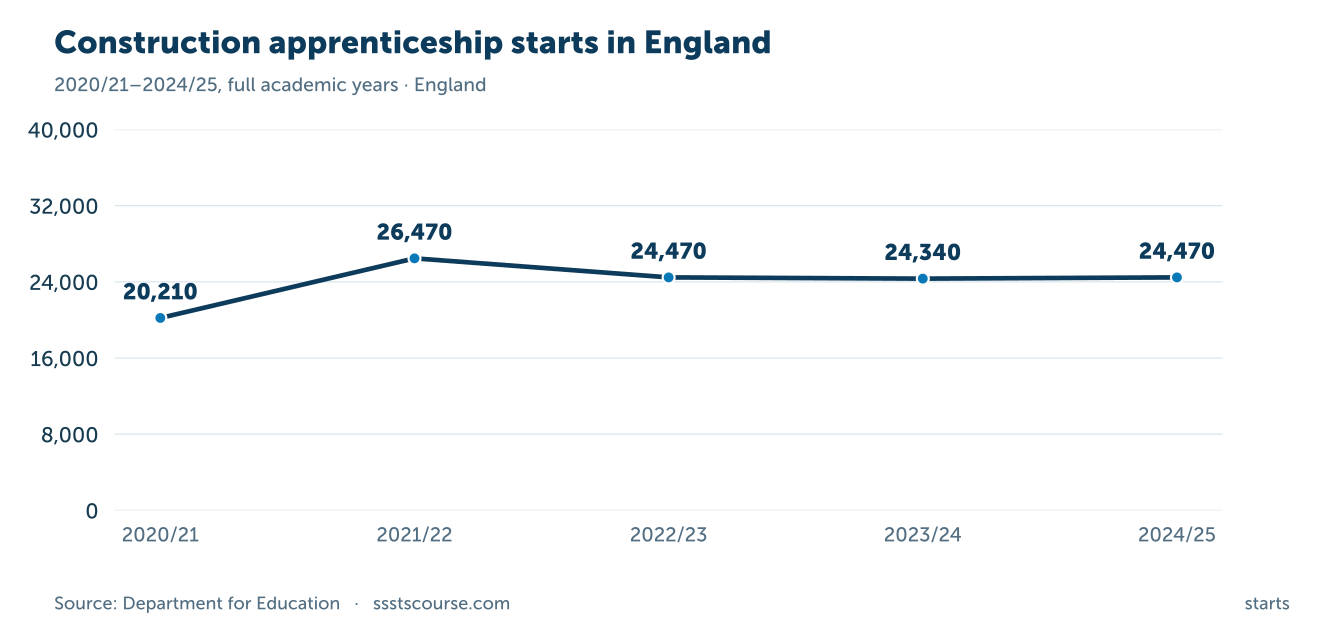
Construction, Planning and the Built Environment subject area. Programme starts, not unique learners. The 2020/21 treatment of extended learning breaks differed from other years.
| Academic year | Starts | Achievements | Enrolments |
|---|---|---|---|
| 2020/21 | 20,210 | 8,730 | 52,230 |
| 2021/22 | 26,470 | 7,550 | 59,190 |
| 2022/23 | 24,470 | 8,460 | 63,840 |
| 2023/24 | 24,340 | 12,880 | 65,200 |
| 2024/25 | 24,470 | 12,980 | 65,320 |
Source: official starts, achievements and enrolments dataset [1]. Academic years run from August to July. Figures use the current revised subject classification.
Achievements increased substantially between 2022/23 and 2023/24, then changed much less in 2024/25. These qualifications were earned by apprentices who generally started in earlier years. Their timing depends on programme length and assessment, so the achievements column does not show how many of that year’s new starters finished.
The pandemic years also need care. Official guidance records disruption to learning and assessment, and a different treatment of extended learning breaks when counting starts in 2020/21. The chart describes the published totals; it cannot isolate the effect of any single policy or economic change. [1]
The latest 2025/26 update
In the first three quarters of 2025/26, construction starts reached 23,900, compared with 22,750 in the equivalent provisional period a year earlier. The government reports growth of 5.0%, using unrounded data. [1]
| Reporting period | Starts | Achievements |
|---|---|---|
| 2024/25 August–April | 22,750 | 8,170 |
| 2025/26 August–April | 23,900 | 9,650 |
Source: in-year subject dataset [1]. Both rows cover August to April. They should be compared with each other, rather than with the full August–July totals above. Provisional returns can change as providers complete their reporting.
Which construction apprenticeship standards have the most starts?
Carpentry and Joinery was the largest standard within the construction subject area in 2024/25, with 3,960 starts. Plumbing and Domestic Heating Technician followed with 2,490, then Bricklayer with 1,910. Chartered Surveyor, a degree apprenticeship, recorded 1,700 starts, illustrating the mix of practical trades and professional occupations in the subject category. [1]
Scroll horizontally to view the full chart on a small screen.
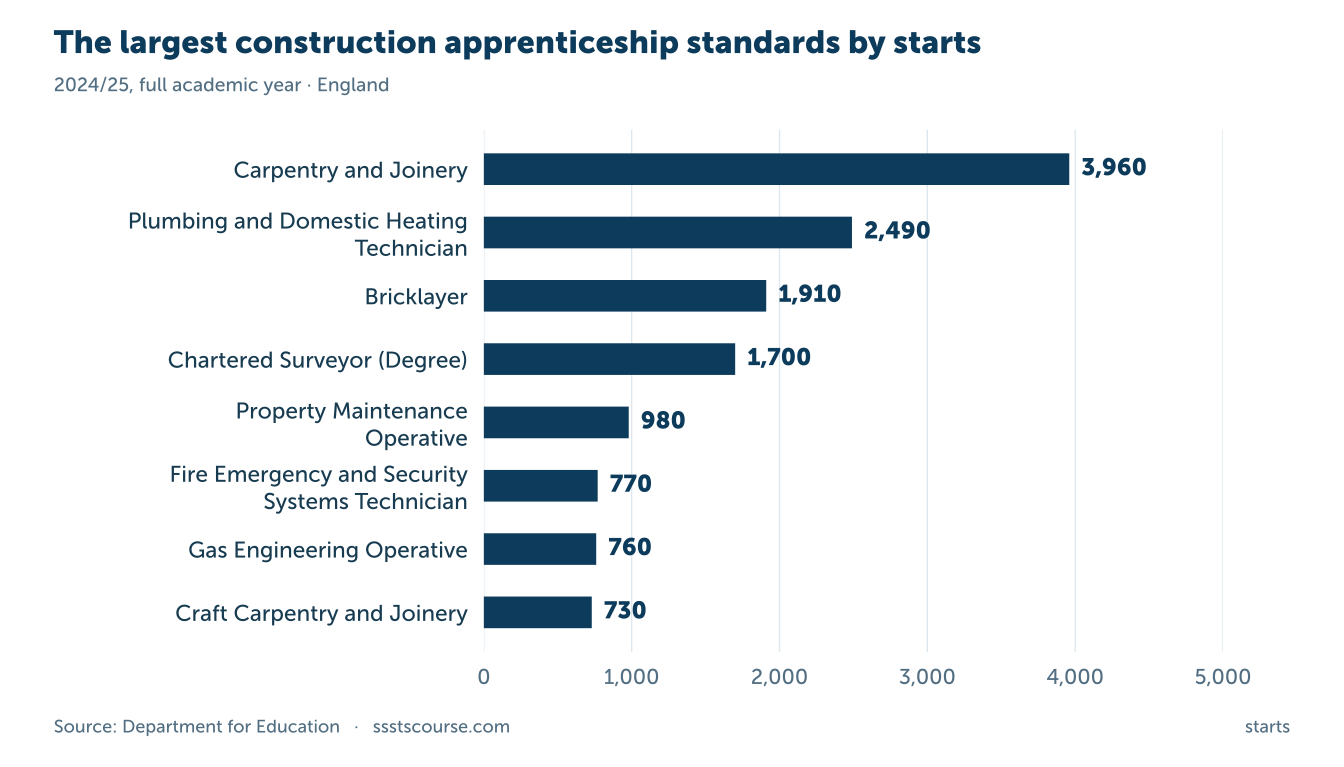
Eight largest standards within the construction subject area. The table gives the ten largest. Other subject areas contain additional construction-related trades.
| Apprenticeship standard | Starts | Achievements |
|---|---|---|
| Carpentry and Joinery (ST0264) | 3,960 | 2,570 |
| Plumbing and Domestic Heating Technician (ST0303) | 2,490 | 1,040 |
| Bricklayer (ST0095) | 1,910 | 1,540 |
| Chartered Surveyor (Degree) (ST0331) | 1,700 | 330 |
| Property Maintenance Operative (ST0171) | 980 | 300 |
| Fire Emergency and Security Systems Technician (ST0189) | 770 | 340 |
| Gas Engineering Operative (ST0155) | 760 | 600 |
| Craft Carpentry and Joinery (ST0263) | 730 | 560 |
| Construction Quantity Surveying Technician (ST0049) | 670 | 400 |
| Groundworker (ST0513) | 670 | 350 |
Source: official standard-level data [1]. Standard codes identify the precise programme. Carpentry and Joinery and Craft Carpentry and Joinery are separate entries; they have not been merged. Starts and achievements in each row relate to different groups of apprentices.
These figures show where training starts are concentrated. They do not rank wages, vacancies or the likelihood of an individual obtaining an apprenticeship. A larger national programme can still have limited availability in a particular town, while smaller standards may serve specialised occupations.
How old are construction apprentices, and which levels do they study?
Nearly half of starts are by under-19s
Under-19s accounted for 12,030 starts in 2024/25. A further 8,760 were by people aged 19–24 and 3,680 by people aged 25 or over. Construction apprenticeships therefore include substantial adult entry as well as starts by younger learners. Age is measured at the beginning of the programme. [1]
| Age | Starts | Share of starts |
|---|---|---|
| Under 19 | 12,030 | 49.2% |
| 19-24 | 8,760 | 35.8% |
| 25+ | 3,680 | 15.0% |
Shares are approximate calculations from rounded published starts. They describe the age mix of programme starts, rather than the current ages of everybody enrolled.
Levels 2 and 3 account for most starts
There were 11,300 Level 2 starts and 7,190 Level 3 starts in 2024/25. Together, these made up 18,490 starts, approximately 75.6% of the construction total. Levels 6 and 7 together accounted for 3,900 starts. [1]
| Level | Starts | Share of starts |
|---|---|---|
| Level 2 | 11,300 | 46.2% |
| Level 3 | 7,190 | 29.4% |
| Level 4 | 2,080 | 8.5% |
| Level 6 | 3,330 | 13.6% |
| Level 7 | 570 | 2.3% |
The range of levels matters when comparing construction with other subject areas. This total combines programmes with different entry requirements, occupations and lengths. A single national average does not describe every route into the industry. Percentages are calculated from rounded figures and may not sum exactly to 100%.
What is the construction apprenticeship achievement rate?
The official construction apprenticeship achievement rate was 58.3% in 2024/25. It increased from 55.5% in 2023/24 and 51.0% in 2022/23: a rise of 7.3 percentage points across the published three-year series. [2]
Scroll horizontally to view the full chart on a small screen.
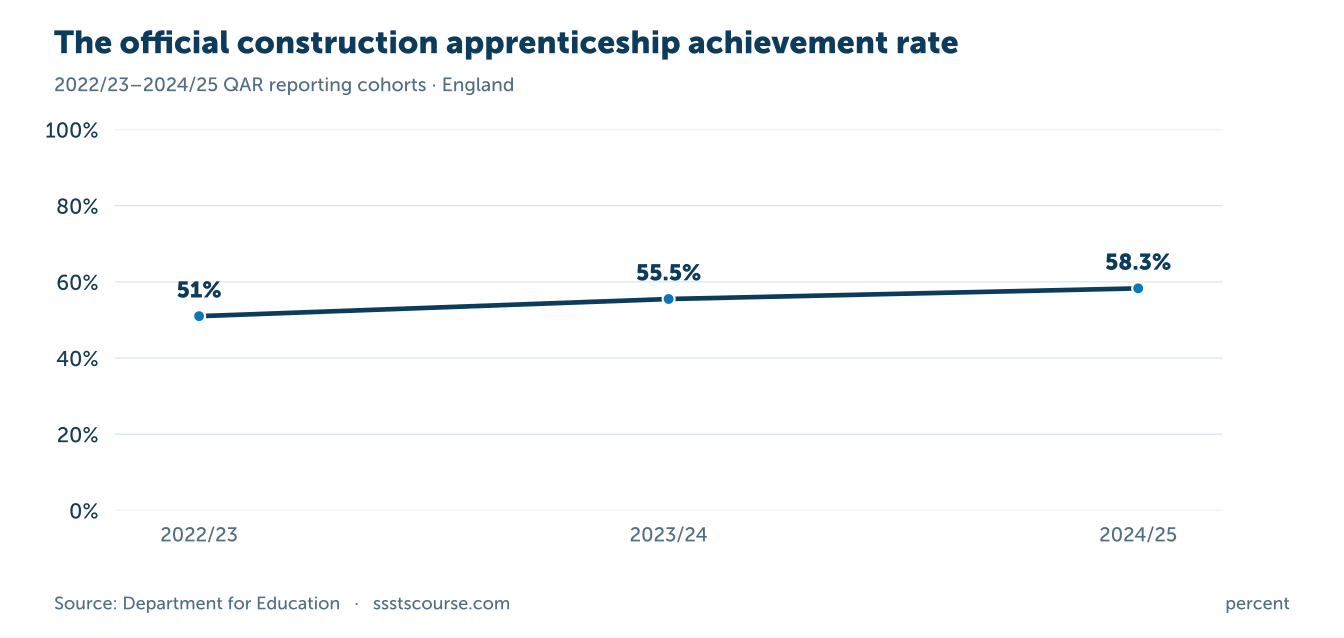
Official qualification achievement rates. These do not divide annual achievements by annual starts. The chart uses a 0–100 scale.
| QAR reporting year | Achievement rate | Retention rate | Pass rate |
|---|---|---|---|
| 2022/23 | 51.0% | 54.3% | 94.1% |
| 2023/24 | 55.5% | 58.5% | 94.9% |
| 2024/25 | 58.3% | 61.8% | 94.3% |
Source: official outcome rates [2]. Percentages are published rates calculated using unrounded data.
The achievement rate considers whether apprentices in the relevant reporting cohort achieved their programme. Retention measures completion of the programme, regardless of whether it was passed. The pass rate concerns those who completed. In 2024/25, construction’s 94.3% pass rate applied to completers; it does not mean that 94.3% of everybody starting an apprenticeship achieved it. [2]
The overall apprenticeship achievement rate across all subjects was 65.4%, placing construction 7.1 percentage points below that benchmark. This is an unadjusted comparison. It does not account for differences in learners, programme duration or the mix of occupations. [2]
Why achievements divided by starts is not a completion rate
Dividing the year’s 12,980 achievements by its 24,470 starts would mix different groups of people. Someone achieving in 2024/25 may have started several years earlier, while a new starter may not be due to finish for several years.
The official qualification achievement rate instead assigns programmes to a reporting cohort using a hybrid end year and applies specified exclusions. Its construction cohort contains 12,920 achievers in 2024/25, rather than the 12,980 achievements in the headline activity series. The two datasets answer different questions. Use the published 58.3% rate when referring to the official achievement measure. [2]; cohort rules [2].
Where are construction apprenticeship starts concentrated?
The latest regional subject data show the North West with 3,750 starts between August 2025 and April 2026, followed by the South East with 3,250 and the South West with 3,130. These are provisional nine-month figures for England’s apprenticeship system. [1]
Scroll horizontally to view the full chart on a small screen.
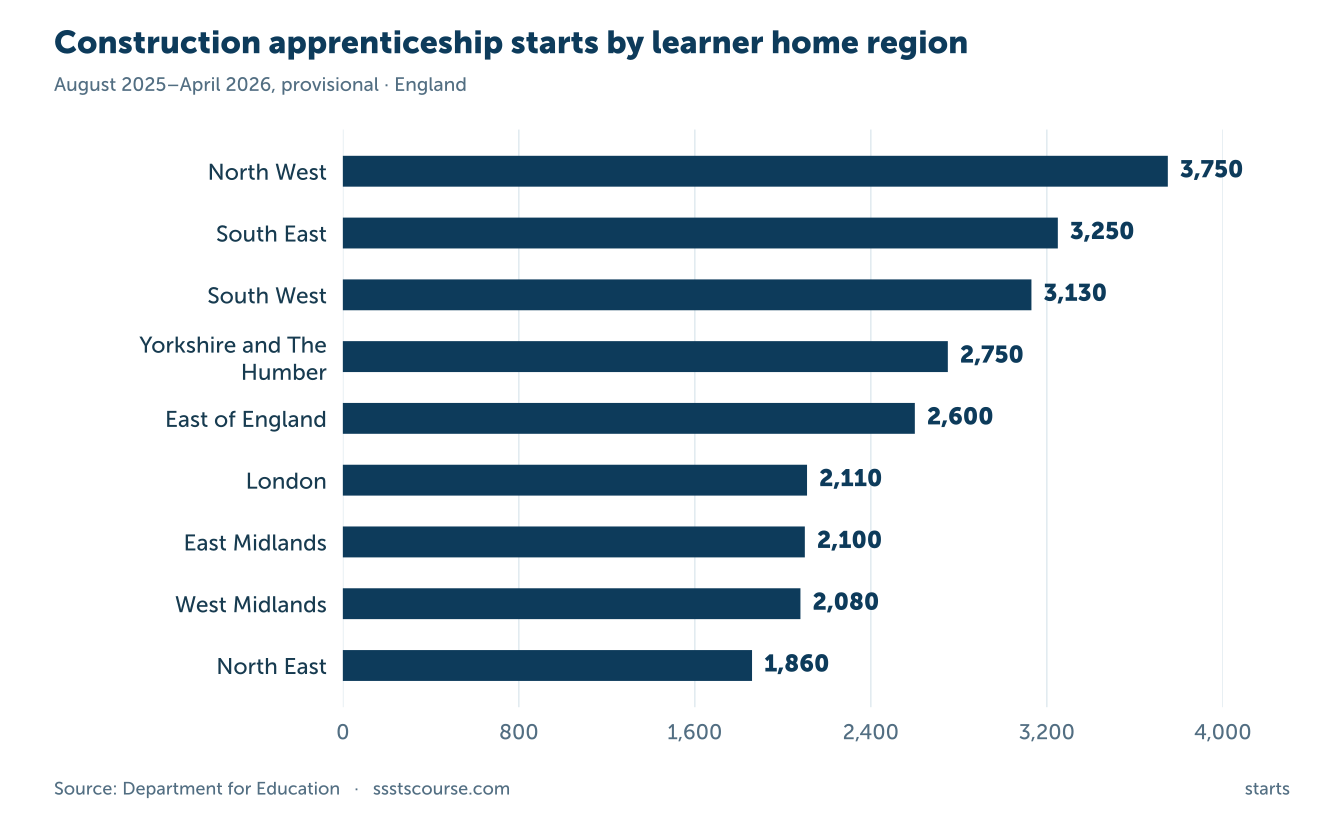
Raw counts are not adjusted for population. Excludes the outside England and unknown category from the chart. This is the latest nine-month snapshot, not a completed academic year.
| Region | Starts | Achievements |
|---|---|---|
| North West | 3,750 | 1,520 |
| South East | 3,250 | 1,350 |
| South West | 3,130 | 1,370 |
| Yorkshire and The Humber | 2,750 | 1,180 |
| East of England | 2,600 | 1,030 |
| London | 2,110 | 660 |
| East Midlands | 2,100 | 800 |
| West Midlands | 2,080 | 910 |
| North East | 1,860 | 760 |
Source: regional starts and achievements [1]. An additional 280 starts and 70 achievements were recorded in the outside England and unknown category, retained in the downloadable dataset. Rounded regional values may not sum exactly to national totals.
Geography follows the apprentice’s home postcode, rather than the location of their employer, college or building site. A person can live in one region and work or train in another. [1]
The ranking also uses raw counts. It does not adjust for population, the size of the regional construction workforce or the number of employers. It is useful for locating the volume of recorded starts, but cannot establish which region offers the best chance of securing an apprenticeship.
Apprenticeships in site supervision and management
The Construction Site Supervisor standard recorded 520 starts, 330 achievements and 1,170 enrolments in 2024/25. The separate Construction Site Management degree standard recorded 230 starts and 60 achievements. In the official data, these are Level 4 and Level 6 programmes respectively. [1]
| Standard | Starts | Achievements | Enrolments |
|---|---|---|---|
| Construction Site Supervisor (ST0048) | 520 | 330 | 1,170 |
| Construction Site Management (Degree) (ST0047) | 230 | 60 | 560 |
These are occupational apprenticeship statistics. They do not count attendance on an SSSTS course. The Site Supervision Safety Training Scheme is a separate two-day course covering supervisors’ health, safety, welfare and environmental responsibilities. Keeping these measures separate makes the data useful for both career planning and training decisions. Our guide to how to become a site supervisor explains how experience, qualification evidence and safety training fit into that progression.
What counts as a construction apprenticeship?
The main series uses the government’s Construction, Planning and the Built Environment sector subject area. This includes craft trades, building-services occupations, surveying, civil engineering and other professional routes. It groups programmes by their subject, rather than counting every apprentice employed by a construction business.
That distinction changes the interpretation of the headline total. For example, the Installation and Maintenance Electrician standard recorded 7,130 starts in 2024/25, but sits under Engineering and Manufacturing Technologies. It is outside the 24,470 construction-subject starts. Adding just that standard would still not produce a complete construction-industry total. [1]
Starts and achievements count apprenticeship programmes. A person starting or achieving more than one programme can appear more than once. Enrolments cover apprenticeships active during the year, including those begun earlier, and are also programme counts. The 65,320 enrolments therefore should not be described as 65,320 distinct people. [1]
Frequently asked questions
How many construction apprentices are there in England?
The construction subject area recorded 65,320 apprenticeship enrolments in 2024/25. This is the number of programmes enrolled on, not necessarily distinct people. There were 24,470 programme starts during the same year. [1]
Are construction apprenticeship starts increasing?
Final starts increased slightly from 24,340 in 2023/24 to 24,470 in 2024/25. The later provisional August–April comparison shows 5.0% growth in 2025/26. A full-year conclusion for 2025/26 requires its final annual release. Annual data [1]; provisional update [1].
Which construction apprenticeship is most common?
Carpentry and Joinery had the most starts within the construction subject area in 2024/25, at 3,960. Some other building-related trades are classified elsewhere, so this is a subject-area ranking rather than a ranking of every apprenticeship associated with construction. [1]
Do these figures cover the whole UK?
No. They cover England’s apprenticeship system. Scotland, Wales and Northern Ireland publish their own apprenticeship statistics under different systems. This page keeps its geographical scope explicit instead of presenting England’s figures as a UK total. [1]
Sources and methodology
Research was checked on 11 November 2026. The principal source is the government’s apprenticeship statistics release updated on 16 July 2026, using Individualised Learner Record returns. Final annual activity covers August to July; the 2025/26 provisional snapshot covers August 2025 to April 2026. Achievement rates use their own reporting cohorts. Latest release [1]; achievement-rate guidance [2].
We use the revised subject classifications published during 2026 throughout the activity comparisons. Older articles and downloads may contain different construction totals because standards were reassigned between subject areas. The government recalculated previous years to support comparison. [1]
Official counts are rounded to the nearest 10. Derived age and level shares are rounded to one decimal place and are approximate. Published rates are retained rather than recalculated from rounded counts. Counts represent programmes, not unique people; the regional analysis uses home addresses. Suppressed small values have not been treated as zero. Source links accompany each table and chart, and the downloadable records retain periods, geography and calculation notes.
Moving from a trade into supervision also changes the responsibilities attached to a job. Our site supervisor salary guide compares official construction pay with the experience and duties described in selected vacancies.