
UK construction and building trades supervisors earn a median £45,510 a year, according to the latest ONS figures. The middle half of full-time employee jobs paid between £37,742 and £55,252. These are gross annual earnings for 2026, with the latest results still provisional. [1]
For career planning, the National Careers Service gives a wider range of £30,000 for a new construction site supervisor to £60,000 for an experienced supervisor. Your responsibilities, location, working hours and employment package matter when comparing an offer with those figures. [2]
In this article
- About these figures
- How much can new and experienced supervisors earn?
- Search salaries in 50 UK locations
- Construction supervisor salaries by region
- Site supervisor day rates and contract pay
- Hourly pay and working hours
- Does SSSTS increase a supervisor’s salary?
- How salaries vary across the industry
- How have construction supervisor salaries changed?
- Frequently asked questions
- Why salary websites give different figures
- Which construction supervisor jobs do the statistics cover?
- Sources and methodology
- Download the data
How much can new and experienced supervisors earn?
The National Careers Service’s £30,000 starter and £60,000 experienced figures give a broad career-planning range. They are estimates assembled from sources such as official statistics, industry information and vacancies. They are not fixed grades, guaranteed offers or the lowest and highest salaries in the market. Salary guidance [2]; how the National Careers Service prepares estimates [2].
Look beyond the title when comparing roles. Supervising your own trade team, coordinating several subcontractors and inspecting work for a client can involve different responsibilities. Check the number of people you would supervise, the project scope and the hours expected before settling on a salary target.
What construction employers ask for at advertised salaries
These three selected advertisements show the work and experience attached to a quoted salary. They were checked on 11 November 2026 and are a small, non-representative set of examples, not a salary survey. The fixed-term vacancy is already closed; it is retained as a dated comparison.
| Role and employment terms | Advertised annual salary | Experience and responsibilities |
|---|---|---|
| Morgan Sindall Property Services, St Albans Permanent, 40 hours a week; posted 29 October 2026 | £35,000–£45,000 plus benefits | Construction, planned-maintenance or refurbishment experience, ideally in social housing; supervision of subcontractors and operatives. The advert requires SMSTS and first aid certification. Advert placed by Iris Recruitment on Work Hub [3]. |
| Mechanical site supervisor, Belfast Permanent; VANRATH advert posted 16 October 2026 | £45,000–£50,000, depending on experience, plus car or allowance and package | Plumbing or heating trade background; coordinates labour, installations and programme reporting for an M&E contractor. Some travel outside Northern Ireland may be required. VANRATH vacancy [4]. |
| Office-refurbishment site supervisor, Reigate Approximately 16-month fixed term; September 2026 advert, now closed | £45,000–£50,000 plus package; direct client PAYE | Mechanical or electrical maintenance/installation background, commercial-site and supervisory experience, CSCS and ability to read technical drawings. Coordinates subcontractors on an office energy-efficiency upgrade. SER Limited archived vacancy [5]. |
Experience is more specific than years served: the trade background, project type and supervision duties in these adverts matter. The St Albans example also requires SMSTS despite using “site supervisor” as its title. Check the actual qualification requirement before booking training. These examples do not establish an experience premium, a regional ranking or a typical construction-wide advertised salary.
Site supervisor salaries in 50 UK locations
Search a town or city, filter by region, or sort the published averages. These figures use Indeed’s broad Site Supervisor job title, which can include construction, school and facilities roles. They are a guide to the advertised market, rather than a comparison of identical construction jobs. [6]
Coverage: 50 selected UK towns and cities, chosen for a spread of major employment centres and all four nations. This is not a population or highest-pay ranking. Last checked ; each publisher update date appears below.
49 locations have a verified published figure. Where a local estimate could not be verified, the table says so; it is not replaced with a regional average.
50 locations shown, in alphabetical order.
Scroll within the table to see every location. On smaller screens, swipe across to see all columns.
| Town or city | Region or nation | Annual average | Salaries reported | Source updated |
|---|---|---|---|---|
| Aberdeen | Scotland | £52,607 | 17Small sample | 14 October 2026 |
| Belfast | Northern Ireland | £40,212 | 13Small sample | 16 October 2026 |
| Birmingham | West Midlands | £35,204 | 52 | 30 October 2026 |
| Blackpool | North West | £27,917 | 11Small sample | 7 September 2026 |
| Bournemouth | South West | £88,798Source snapshots differ | 5Small sample | 6 July 2026 |
| Bradford | Yorkshire and the Humber | £25,420 | 19Small sample | 13 October 2026 |
| Brighton | South East | £57,657Source snapshots differ | 4Small sample | 29 October 2026 |
| Bristol | South West | £32,372 | 50 | 26 September 2026 |
| Cambridge | East of England | £65,706 | 9Small sample | 4 October 2026 |
| Cardiff | Wales | £44,796 | 10Small sample | 16 September 2026 |
| Coventry | West Midlands | £64,741 | 13Small sample | 26 October 2026 |
| Derby | East Midlands | £38,741Source snapshots differ | 13Small sample | 24 October 2026 |
| Derry | Northern Ireland | £48,176 | 2Small sample | 31 October 2026 |
| Doncaster | Yorkshire and the Humber | £26,380 | 22Small sample | 8 October 2026 |
| Dundee | Scotland | £60,953 | 6Small sample | 25 February 2026 |
| Edinburgh | Scotland | £34,808 | 9Small sample | 11 September 2026 |
| Exeter | South West | £51,247Source snapshots differ | 11Small sample | 19 August 2026 |
| Glasgow | Scotland | £43,299Source snapshots differ | 24Small sample | 15 October 2026 |
| Huddersfield | Yorkshire and the Humber | £33,277 | 5Small sample | 2 September 2026 |
| Inverness | Scotland | £64,309 | 5Small sample | 14 July 2026 |
| Kingston upon Hull | Yorkshire and the Humber | £55,184 | 5Small sample | 13 October 2026 |
| Leeds | Yorkshire and the Humber | £30,504Source snapshots differ | 37 | 21 October 2026 |
| Leicester | East Midlands | £39,774 | 15Small sample | 24 September 2026 |
| Liverpool | North West | £35,994 | 13Small sample | 5 October 2026 |
| London | London | £41,013 | 167 | 28 October 2026 |
| Luton | East of England | £70,709 | 4Small sample | 15 September 2026 |
| Manchester | North West | £76,024Source snapshots differ | 16Small sample | 29 October 2026 |
| Middlesbrough | North East | £29,163 | 8Small sample | 6 August 2026 |
| Milton Keynes | South East | £40,291 | 13Small sample | 9 October 2026 |
| Newcastle upon Tyne | North East | £36,535 | 9Small sample | 18 October 2026 |
| Newport | Wales | £50,493 | 4Small sample | 30 June 2026 |
| Northampton | East Midlands | £45,869 | 10Small sample | 29 October 2026 |
| Norwich | East of England | £65,824Source snapshots differ | 10Small sample | 19 August 2026 |
| Nottingham | East Midlands | £47,903 | 11Small sample | 30 October 2026 |
| Oxford | South East | £39,132 | 11Small sample | 2 September 2026 |
| Peterborough | East of England | £34,388 | 9Small sample | 14 October 2026 |
| Plymouth | South West | £69,508Source snapshots differ | 8Small sample | 23 October 2026 |
| Portsmouth | South East | £61,346 | 5Small sample | 12 August 2026 |
| Preston | North West | £45,236Source snapshots differ | 27Small sample | 17 October 2026 |
| Reading | South East | £35,912Source snapshots differ | 10Small sample | 20 September 2026 |
| Sheffield | Yorkshire and the Humber | £44,060Source snapshots differ | 6Small sample | 22 July 2026 |
| Southampton | South East | £42,933Source snapshots differ | 11Small sample | 29 October 2026 |
| Southend-on-Sea | East of England | £79,197 | 2Small sample | 22 July 2026 |
| Stoke-on-Trent | West Midlands | £30,545Source snapshots differ | 11Small sample | 28 October 2026 |
| Sunderland | North East | £49,643 | 8Small sample | 23 October 2026 |
| Swansea | Wales | £67,015 | 6Small sample | 18 September 2026 |
| Swindon | South West | No verified figure | — | Not available |
| Warrington | North West | £42,154 | 12Small sample | 30 October 2026 |
| Wolverhampton | West Midlands | £36,079 | 13Small sample | 1 July 2026 |
| York | Yorkshire and the Humber | £45,219 | 4Small sample | 20 August 2026 |
No locations match those filters. Try another place or reset the filters.
“Small sample” means fewer than 30 salaries reported; it is our caution, not an Indeed confidence rating. Different locations contain different mixes of jobs and source dates. Some source snapshots also differ sharply; these are flagged and the observations are retained in the evidence download. A high average does not establish higher pay for the same construction role.
Download all 50 locations (CSV)Download local sources and methodology (JSON)
Construction supervisor salaries by region
ONS publishes regional estimates for the same occupation, making the role definition more consistent than comparisons between unrelated job-board titles. The table below uses workplace region and full-time annual gross pay. Published 2026 medians range from £43,100 in the South West to £48,562 in the East Midlands, but the uncertainty is too large to treat that order as a dependable ranking. [1]
| Workplace region | Median annual pay |
|---|---|
| North East | Suppressed |
| North West | £46,740 |
| Yorkshire and The Humber | £44,543 |
| East Midlands | £48,562 |
| West Midlands | £45,407 |
| South West | £43,100 |
| East | £46,842 |
| London | Suppressed |
| South East | £45,379 |
| Wales | Suppressed |
| Scotland | £44,753 |
London, the North East and Wales do not have a published median in this table. No Northern Ireland row is available. Use matching local vacancies alongside these estimates; the regional figures are too uncertain to establish a reliable pay ranking.
View the regional salary chart
Scroll horizontally to view the full chart on a small screen.
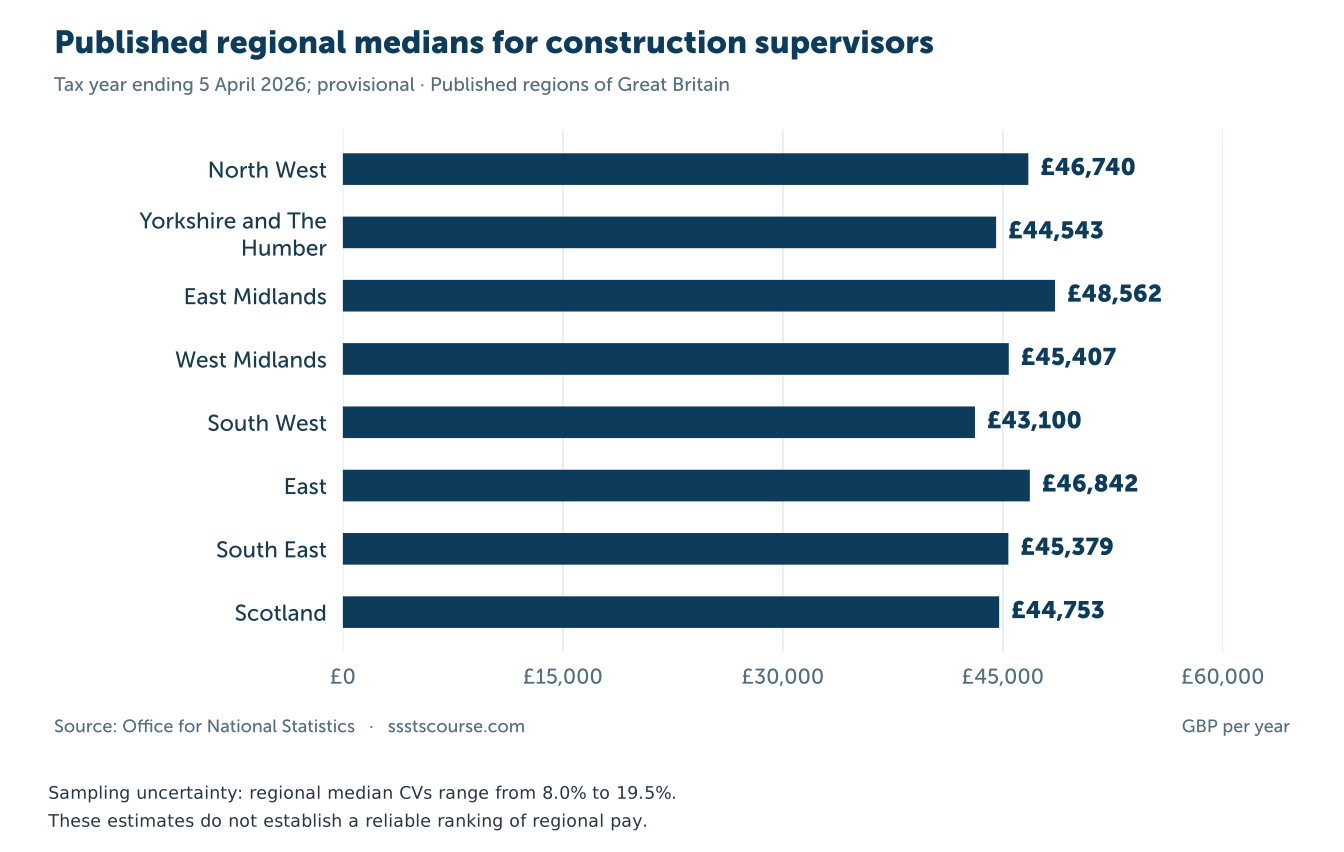
Full-time employees, SOC 2020 code 5330, workplace region. Regional uncertainty is substantial: median CVs range from 8.0% to 19.5%. London, North East and Wales medians are suppressed. No Northern Ireland row is provided. This is not a reliable ranking of regional pay.
Site supervisor day rates and contract pay
Contract advertisements show how much the role’s scope can change the quoted rate. The following are individual vacancies checked in November 2026, not a market average or a recommended rate.
| Role and location | Advertised rate | Relevant context | Source |
|---|---|---|---|
| Mechanical site supervisor, Wakefield | £240 per day in the advert body | Ongoing freelance work covering mechanical/heating installation, team coordination and pricing or costing. Summary range displays £240–£241. | Randstad, posted 27 October 2026 [7] |
| NEC site supervisor, South West highways projects | £400 per day | Specialist construction assurance and NEC contract supervision; six-day working programme, intended to run from mid-October 2026 to 31 March 2027. | Hays, posted 21 September 2026 [8] |
The £400 example involves a specialist contractual function and a six-day programme. It does not establish a standard day rate for a construction foreman. Equally, the two advertisements cannot show that the South West pays more than West Yorkshire: their duties, project requirements and working patterns differ.
Comparing a day rate with a permanent salary
As an illustration, £240 × 220 paid days = £52,800. The 220 days are an assumption, not a promise of work or a statistic about typical contracts. The result is a gross contract amount before any applicable deductions or costs; it is not automatically equivalent to a £52,800 permanent salary.
Before comparing offers, establish the payment basis, expected paid days, holiday arrangements, pension provision, travel or accommodation costs, overtime, equipment and gaps between assignments. Ask whether the advertised rate is the amount payable to you or an assignment rate with other costs included. Use the actual contract terms rather than assuming that every day-rate vacancy follows the same arrangement.
Hourly pay and working hours
The 2026 median hourly rate excluding overtime was £21.03 for full-time construction and building trades supervisors. Median total paid hours were 40 a week; the mean was 42.7 hours. The hourly median increased from £19.57 in 2024 and £20.43 in 2025. [1]
| Measure | Median | Mean |
|---|---|---|
| Hourly pay excluding overtime | £21.03 | £22.07 |
| Total paid hours per week | 40.0 | 42.7 |
The annual and hourly figures answer different questions. Hourly estimates refer to an April pay period; annual estimates cover the preceding tax year and require more than a year in the same job. Multiplying the hourly median by the hours median and by 52 will not reproduce annual median earnings.
When reviewing an offer, check the contracted hours, paid overtime rules, weekend requirements and travel arrangements together. A higher annual amount can reflect a longer working week. The advertised number is more useful once you understand what time and responsibilities it pays for.
For people progressing from a trade into supervision, our construction apprenticeship statistics explain the training routes and distinguish trade programmes from higher-level construction supervision.
Does SSSTS increase a supervisor’s salary?
SSSTS can be relevant to eligibility for a role, but the sources reviewed here do not establish a measurable salary premium for holding it. The Wakefield mechanical supervisor vacancy asks for SSSTS or SMSTS, alongside a CSCS card, trade expertise and commercial skills. That demonstrates an employer requirement; it does not isolate the effect of the certificate on pay. [7]
CITB describes the SSSTS course as a two-day course for people who have, or are about to take on, supervisory responsibilities. It covers safe supervision, risk controls and communication. Certification lasts five years, with renewal required to maintain certification. Salary expectations should still be based on the job’s responsibilities, experience requirements and employment terms. [9]
How salaries vary across the industry
ONS offers a different way to assess the spread of pay. In 2026, the lower quartile was £37,742, the median £45,510 and the upper quartile £55,252. These are positions within the full-time employee earnings distribution. A lower-paid employee is not necessarily a beginner, and an experienced supervisor is not automatically in the upper quartile. [1]
Scroll horizontally to view the full chart on a small screen.
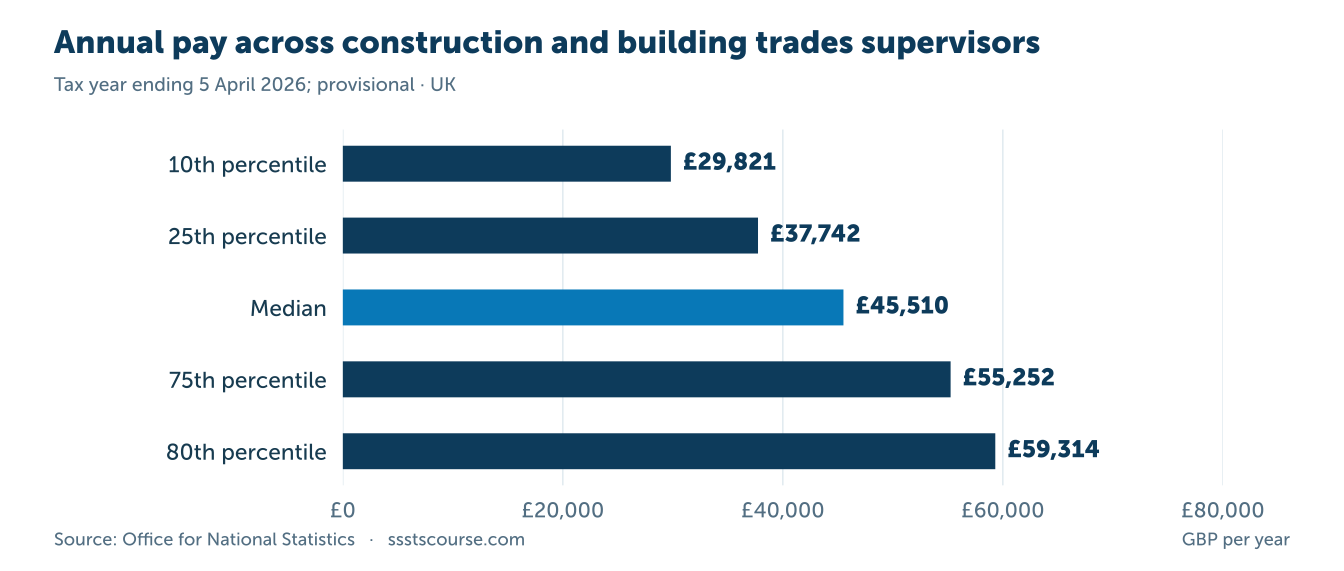
Full-time employee jobs, SOC 2020 code 5330. Percentiles describe positions in the pay distribution, not years of experience. The 90th percentile is suppressed by ONS.
View the pay distribution figures
| Position in distribution | Annual pay | How to interpret it |
|---|---|---|
| 10th percentile | £29,821 | About one in ten relevant jobs paid below this figure |
| 25th percentile | £37,742 | Lower boundary of the middle half of jobs |
| Median | £45,510 | The midpoint of the distribution |
| 75th percentile | £55,252 | Upper boundary of the middle half of jobs |
| 80th percentile | £59,314 | About one in five relevant jobs paid above this figure |
| 90th percentile | Not published | Suppressed by ONS; no value has been estimated here |
A £60,000 offer is therefore towards the higher end of this published distribution, although specialist roles can differ. Check whether a quoted figure is basic salary or expected earnings including overtime before comparing it with annual gross pay.
How have construction supervisor salaries changed?
Median annual gross pay rose from £41,752 in 2024 to £45,062 in 2025 and £45,510 in 2026. The latest published annual increase was 1.0%, following 7.9% in 2025. The 2024 and 2025 figures are revised; 2026 remains provisional. [1]
Scroll horizontally to view the full chart on a small screen.
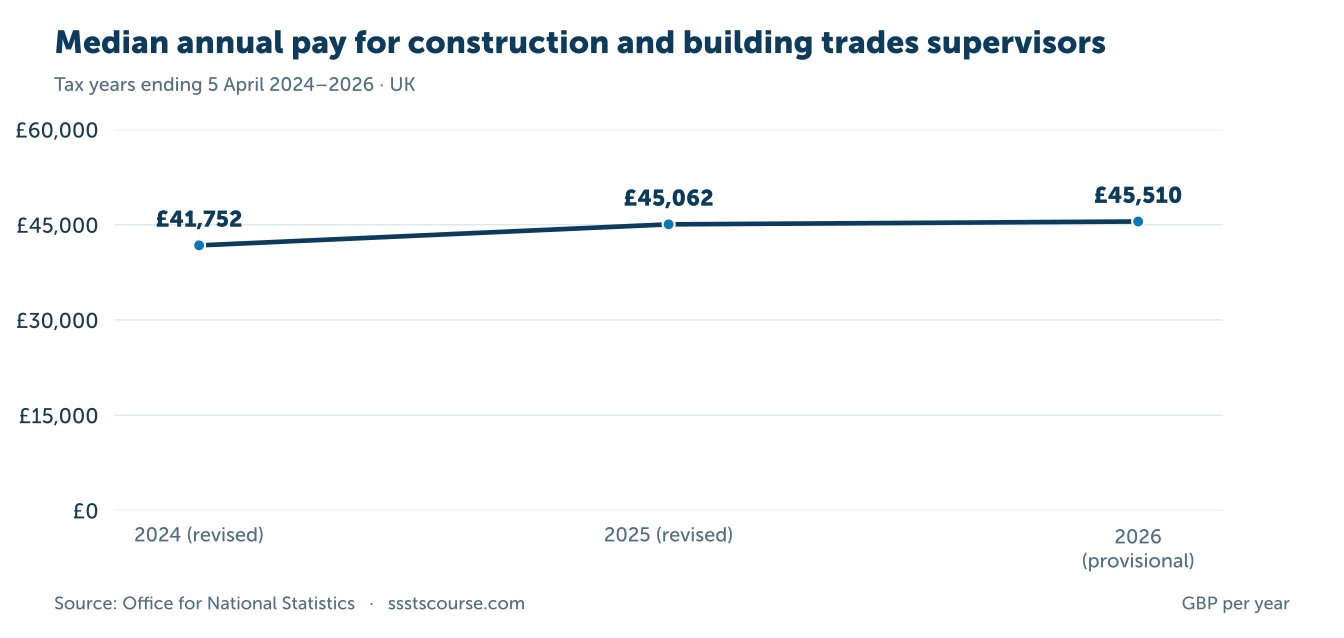
Full-time employee jobs, SOC 2020 code 5330. 2024 and 2025 revised; 2026 provisional. Nominal amounts, not adjusted for inflation. Workforce changes can affect the median.
View the annual earnings figures
| Tax year ending | Median | Mean | Annual change in median | Status |
|---|---|---|---|---|
| 5 April 2024 | £41,752 | £43,132 | 6.1% | Revised |
| 5 April 2025 | £45,062 | £46,857 | 7.9% | Revised |
| 5 April 2026 | £45,510 | £47,690 | 1.0% | Provisional |
These are cash values, without an inflation adjustment. They also compare the occupation in successive years, rather than tracking an identical set of individuals. Recruitment, departures and changes in the mix of jobs can shift the median. A 1.0% movement in the statistic does not mean every supervisor received a 1.0% pay rise.
Frequently asked questions
What is the average construction site supervisor salary in the UK?
For full-time construction and building trades supervisors, ONS reports a 2026 provisional median of £45,510 and mean of £47,690 in annual gross pay. Indeed’s £35,284 average covers the broader site-supervisor title in job postings. Use the construction occupation when benchmarking a trade-supervision role, and check duties before comparing advertised salaries.
Is £50,000 a good site supervisor salary?
£50,000 is above the ONS national median of £45,510 and below the upper quartile of £55,252 for the defined occupation. Whether an offer is attractive also depends on working hours, overtime, location, travel and the benefits package. The headline amount alone does not settle the comparison.
Can an experienced site supervisor earn £60,000?
The National Careers Service uses £60,000 as its experienced salary guidance. In the ONS full-time construction-supervisor distribution, the 80th percentile is £59,314. That makes £60,000 plausible towards the higher end of this distribution, rather than a salary that all experienced supervisors should expect.
How much do site supervisors earn in London?
ONS suppresses the 2026 full-time annual median for construction and building trades supervisors in London. There is no reliable median to report from that table. A London figure from a different salary website may describe a broader job title or advertised pay, so it should be labelled with its own source and coverage.
Why salary websites give different figures
Compare the four salary measures and their sources
| Source and measure | Amount | Coverage | Period |
|---|---|---|---|
| ONS median annual gross pay [1] | £45,510 | Full-time employee jobs in construction and building trades supervision, SOC 2020 code 5330 | Tax year ending 5 April 2026; provisional |
| ONS mean annual gross pay [1] | £47,690 | The same occupation and annual-pay population | Tax year ending 5 April 2026; provisional |
| National Careers Service guidance [2] | £30,000–£60,000 | Estimated starter-to-experienced range; profile also covers inspection and quality assurance | Checked 11 November 2026 |
| Indeed average base salary [6] | £35,284 | Broad site-supervisor job title; 1.7k salaries reported from postings over the preceding 36 months | Updated 2 November 2026 |
The ONS median is the middle of the earnings distribution: half of the relevant employee jobs fall below it and half above. The mean adds together earnings and divides by the number of jobs, making it more sensitive to higher-paid roles. Both describe actual gross employee earnings; neither is a minimum salary employers must offer.
Indeed provides a useful view of advertised pay, but its page does not state that the sample is restricted to construction. The title itself appears in other sectors: Hays lists school site-supervisor roles alongside construction vacancies. This is one reason to compare the duties and sector before using a headline average. The differences between sources cannot be attributed to sector alone; the populations, periods and measures also differ. Indeed methodology and figure [6]; Hays job-title examples [8].
Which construction supervisor jobs do the statistics cover?
Our main official benchmark uses SOC 2020 code 5330, Construction and building trades supervisors. ONS describes workers who coordinate construction trades and subcontractors, organise schedules and report to managers. Its related titles include construction foreman, construction supervisor and site foreman. This is a close fit for many people moving from a trade into frontline site supervision. [10]
A vacancy called “site supervisor” may instead emphasise mechanical installations, quality inspection, facilities upkeep or the contractual NEC Supervisor function. The National Careers Service profile includes site inspector and clerk of works among its alternative titles. The common title does not make these interchangeable jobs. National Careers Service role definition [2].
For a useful pay comparison, establish whether you will supervise a trade team, coordinate several subcontractors, inspect work for a client, or take responsibility for the overall site programme. Compare vacancies with similar responsibilities, hours and contract arrangements. Construction-manager and director statistics describe a separate occupational group and are not used as supervisor earnings here.
Sources and methodology
The official earnings analysis uses the Annual Survey of Hours and Earnings, Table 14 [1], full-time sheets for SOC 2020 code 5330. We use revised 2024 and 2025 results and provisional 2026 results. Annual gross earnings come from Table 14.7a; quality measures from 14.7b; hourly pay excluding overtime from 14.6a; and total paid hours from 14.9a. Regional figures use Table 15, four-digit occupation files 15.7a and 15.7b [1].
ASHE is an employer survey based on a 1% sample of PAYE jobs. It covers employee jobs and excludes self-employed workers. Annual figures concern adult-rate employees who have been in the same job for more than a year, over the tax year ending 5 April. Hourly and weekly measures concern an April pay period and exclude employees whose pay was affected by absence. A person with more than one job can appear more than once.
Figures are rounded to whole pounds in the annual-pay tables; downloaded data retain published precision. Missing and suppressed values are not treated as zero. Job-count columns in ASHE are indicative workforce estimates, not survey sample sizes. The regional 2026 files were available when checked, although the ONS landing page still carried an earlier delay notice; no more precise regional publication date is assumed.
Career guidance, job-board averages and individual vacancies retain their own dates and definitions. We have not combined them into a synthetic average, calculated a qualification premium or converted advertised day rates into claimed permanent salaries. Vacancy links and job-board values may change after the review date. Use the accompanying source register and downloadable data to trace each figure.
How precise are the regional estimates?
The coefficient of variation, or CV, measures sampling uncertainty relative to the estimate. Lower is better. ONS considers CVs above 10% and up to 20% acceptable, but less precise than the national median, whose CV is 3.7%. All published regional medians except the South West fall in that 10–20% band. ONS suppresses unreliable estimates and figures that could disclose individual information. Suppressed does not mean zero.
No Northern Ireland row for this occupation appears in the downloaded regional file. We have also left London’s median blank rather than substituting its mean, which would change the measure. For an individual offer, local vacancies with matching duties provide useful additional context; the table alone cannot establish a regional salary premium.
View regional sampling uncertainty
| Workplace region | Median annual pay | Coefficient of variation |
|---|---|---|
| North East | Suppressed | Not published |
| North West | £46,740 | 10.9% |
| Yorkshire and The Humber | £44,543 | 18.7% |
| East Midlands | £48,562 | 17.9% |
| West Midlands | £45,407 | 19.5% |
| South West | £43,100 | 8.0% |
| East | £46,842 | 13.8% |
| London | Suppressed | Not published |
| South East | £45,379 | 10.5% |
| Wales | Suppressed | Not published |
| Scotland | £44,753 | 12.7% |