
RAMS stands for risk assessments and method statements. A useful RAMS briefing connects the current risk assessment and method statement to the work people are about to do. The team should understand the sequence, the controls they depend on, the limits of their role and what to do if conditions change. Reading a document aloud and collecting signatures does not establish that understanding.
This guide helps a supervisor prepare, brief, check and record that conversation. It does not provide a ready-made method for a particular task. The completed example is fictional; use the records with your employer’s arrangements.
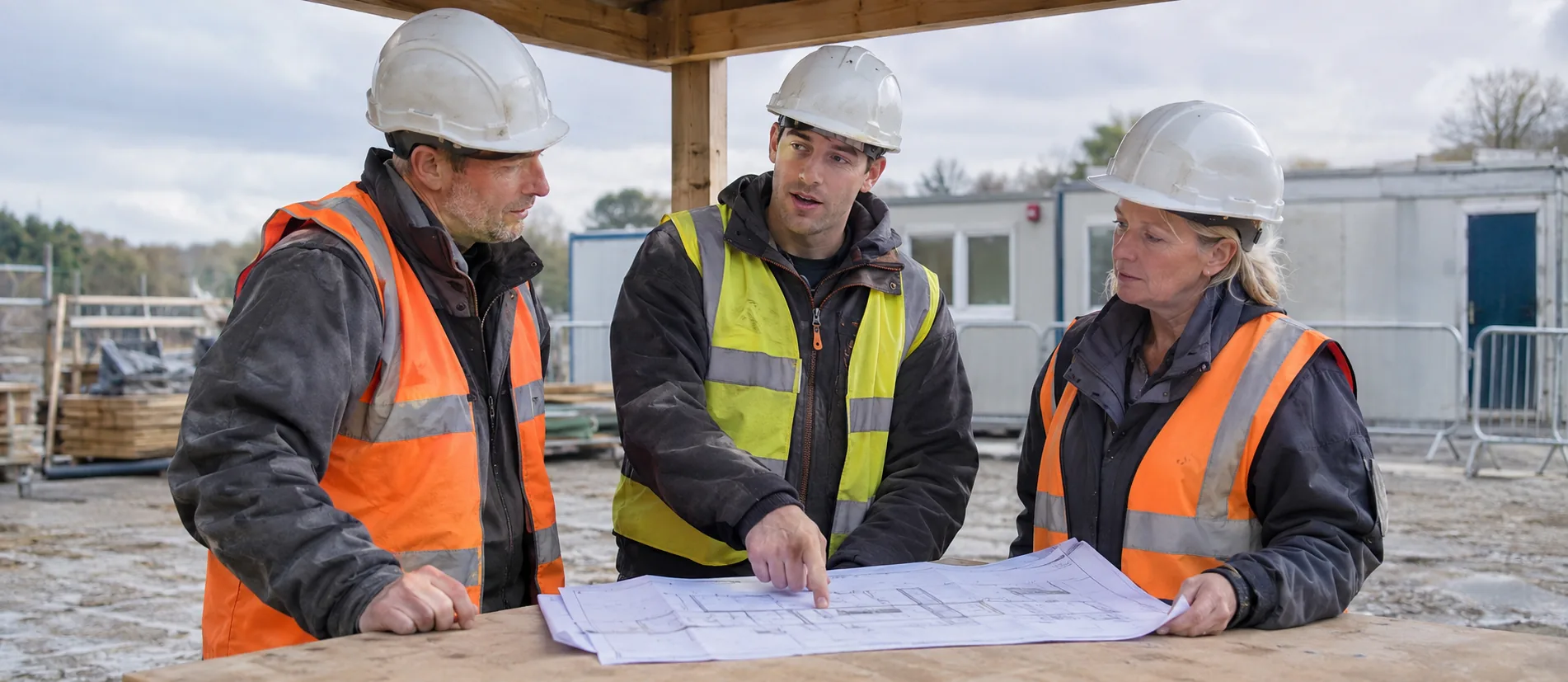
From the paperwork to the work
Use the guide in the order you need it: prepare the briefing, explain the task, then check what happens on site.
In this guide
What does RAMS mean in construction?
Risk assessments and method statements serve different purposes. Together, they connect the risks and controls to the way a task will be carried out. A briefing brings those arrangements to the people doing and affected by the work. For supervisors developing this knowledge, the SSSTS course covers risk controls and communication.
Risk assessment
Identifies how people could be harmed and the controls needed.
What could cause harm, and how will the risk be controlled?
Method statement
Explains the work sequence and how those controls are applied.
How will this task be carried out with the controls in place?
Scroll sideways to compare all columns. Keyboard: focus the table and use the arrow keys.
| Task | What it should establish |
|---|---|
| Document review and authorisation | The assigned competent people check suitability, technical requirements and the employer's process for authorising the method for use. |
| Team briefing | The relevant people understand this task, this revision, the controls, interfaces and stop points. Questions are resolved or recorded with restrictions. |
| Workplace follow-up | The agreed arrangements are present, usable and followed; changes trigger further review where needed. |
A supervisor may contribute practical knowledge to reviewing controls, within competence and authority. That does not make the briefing an approval of specialist design or an instruction to improvise missing technical detail. The managerial RAMS review checklist covers the separate review task; daily supervisor responsibilities explain the wider monitoring and escalation role.
HSE's CDM guidance on supervision and instructions emphasises appropriate supervision and timely information that people can understand. The checklist and record here are original practical prompts, not a prescribed statutory form.
HSE's contractor guidance describes planning, managing and monitoring work in Great Britain. Northern Ireland has a separate CDM 2016 framework . A form called “RAMS” is not a substitute for the applicable arrangements or a universal legal requirement for every task.
RAMS briefing checklist: before you start
Read the relevant documents and look at the task conditions. Use this pre-brief check to find mismatches while there is time to resolve them:
Review the eight preparation points
Tick a point when you have reviewed it. A completed checklist is not approval to start work: unresolved controls or questions still need the appropriate action and authorisation. Download a record below to keep the facts and decisions.
For example, if the document uses a pedestrian entrance that has been blocked by stored materials, do not point the team towards an improvised shortcut. Record the mismatch, maintain the necessary restriction and refer it to the person responsible for resolving the arrangement. An action's due time is not permission to proceed if the control is still missing.
If there is serious or imminent danger, stop the affected work, report it and move to safety. Do not wait for a document reference or signature before taking the necessary protective action.
Explain the work and check understanding
Use the work area or a suitable plan where it is safe to do so. Explain the task in sequence, using the actual locations and equipment rather than only document headings:
- Set the task: identify the activity, current document revision and what this briefing covers.
- Walk through the sequence: explain the preparation, work stages, handovers and completion arrangements relevant to each role.
- Identify essential controls: show the agreed access, separation, equipment or other arrangements people rely on. Explain who checks them and what must happen before starting.
- Describe the stop and escalation points: make clear which change, failure or uncertainty requires the affected work to pause and whom to contact.
- Ask, listen and resolve: invite concerns, check understanding and record unanswered questions with an owner and restriction.
Three useful understanding prompts
- “Describe your first step and the check you need before you begin.”
- “Which control protects you or another person here, and how will you know it is in place?”
- “What change would make you pause, and who would you contact?”
“I have signed it” does not answer those questions. HSE's information and training guidance calls for checking understanding. If someone cannot identify the agreed pedestrian route, explain it again and ask them to describe it back from a safe location. Do not ask them to demonstrate an unfamiliar hazardous operation merely to prove understanding.
HSE's workplace language guidance includes appropriate translation and interpreting support. Use comprehensible information and check the meaning has been understood. This is a workplace briefing, where communication arrangements differ from the rules for a CITB course examination.
Explain unfamiliar terms briefly: an interface is where activities affect each other; a stop point is a condition requiring a pause; a revision identifies a controlled document change. An action owner is the person responsible for resolving a recorded issue—not automatically the person who noticed it.
Work through a changed-access example
Fictional learning example: at Willow Gate refurbishment, a delivery of packaged materials is planned beside an active work area. The current method, WG-07 revision 2, refers to a pedestrian entrance now blocked by temporary storage. A suggested shortcut would enter the vehicle approach. This example records the communication and review process; it does not specify a safe traffic design for real use.
- 08:10—mismatch found. Tara, the supervisor, pauses the affected delivery activity and explains the restriction to the crew. The team does not use the suggested shortcut. Question Q01 records: “What authorised pedestrian access will apply while this entrance is unavailable?”
- Review assigned. Lee, the responsible manager in this fictional example, arranges competent review of access, vehicle separation and the adjoining work. Q01 has an owner and a target response time; it remains open until the actual arrangement is resolved.
- 08:45—revised instructions issued. Following that review, WG-07 revision 3 is authorised under the fictional employer's process. The change concerns the access arrangement and its interfaces. Revision 2 is withdrawn from this task's briefing set; the supervisor does not invent or self-approve the route.
- 08:55 onward—rebrief and verification. Tara briefs the four-person crew on revision 3, asks the three understanding questions and resolves their responses. The responsible people verify the revised controls are in place. Lee authorises restart at 09:05 under the site's arrangements; Tara checks implementation again at 09:20.
The completed record closes Q01 with the new document reference, rebrief time, verification and restart decision. “Photo taken” or “team signed” alone would not show that the access conflict had been resolved. A worker arriving after the rebrief needs the relevant briefing before joining the affected task.
HSE's construction traffic guidance supports planning routes and separating pedestrians and vehicles. The timings and names above are fictional, not prescribed deadlines or authority for the reader to approve a layout.
Observe the work, then review and rebrief when needed
Visit the task after the briefing. Check that the agreed equipment, access and controls exist and can be used as intended; ask whether the method is workable. HSE's method-statement guidance also calls for checking actual practice. The inspection guide will help record and verify inspection actions.
Triggers for another look include different plant or materials, changed weather or ground conditions, new personnel, a revised sequence, other work entering the area, an ineffective control or a worker's concern. HSE's risk-management guidance explains reviewing controls after relevant changes or concerns. Not every change has the same significance: follow the employer's review arrangements and refer technical questions to the competent person responsible.
Keep affected work restricted where necessary while the issue is resolved. Once a revised method is authorised for use, remove superseded instructions from use at the task, tell affected people what changed, check understanding again and verify implementation. Preserve the revision history under the employer's record arrangements; do not silently overwrite the old briefing as though the change never happened.
Use the blank and completed records
The original briefing record is an aid to communication and follow-up. It is not an approved safe system of work, a substitute risk assessment or evidence that every attendee is competent. Use only the personal information needed under the employer's record arrangements.
Scroll sideways to compare all columns. Keyboard: focus the table and use the arrow keys.
| Field | What to record | Fictional example |
|---|---|---|
| Task and location | The specific activity and area covered. | Willow Gate refurbishment: a packaged-material delivery beside an active work area. |
| Document control | Reference, revision, date, author and the relevant authorisation status. | WG-07 revision 2 is replaced by revision 3, authorised at 08:45 after competent review. |
| Briefing details | Date, time, briefer and attendees or role references under employer arrangements. | Tara briefs the four-person crew on revision 3 from 08:55. |
| Sequence and controls | The task stages, interfaces, essential controls and stop points discussed. | The revised access arrangement, vehicle separation, interfaces and checks required before restarting. |
| Understanding checks | The prompts used, meaningful responses and clarification needed. | Tara asks the three understanding prompts and resolves the crew’s responses before the affected work resumes. |
| Questions and restrictions | Unresolved issues and which activity must remain paused or restricted. | Q01: which authorised access applies while the entrance is blocked? The affected delivery remains paused; the vehicle approach is not a shortcut. |
| Actions | Action, owner, target time, status and evidence of actual resolution. | Lee arranges competent review. Q01 remains open until the actual arrangement is resolved, regardless of its target response time. |
| Rebrief and follow-up | Revised document, people rebriefed, verification, authorised restart where relevant and later observation. | Controls are verified, Lee authorises restart at 09:05, and Tara checks implementation again at 09:20. |
Download the blank editable briefing record or download the separate fictional completed example. Replace placeholders and apply the employer's arrangements before real use.
A RAMS briefing covers the task's method and controls. HSE's site-induction guidance addresses wider site arrangements, reflected in the site-wide induction checklist. An operational toolbox-talk template supports a focused safety discussion. They complement rather than replace the task briefing. For learners, the SSSTS assessed toolbox-talk task is a separate course activity.
Choose the separate blank record or fictional example in editable Excel, printable PDF or text. The matching fields help you compare your record with the example. Expand spreadsheet rows when you need more space.
Common RAMS briefing questions
Are RAMS a legal requirement?
In Great Britain, employers must assess and manage risks. The label “RAMS” is not itself a blanket requirement for every task. Method statements are a practical way to set out the work and controls. Some activities require written arrangements before work begins, including demolition, dismantling and structural alteration. Follow the applicable duties and competent site arrangements. Northern Ireland has its separate CDM framework.
What is a RAMS briefing?
It is a task-specific discussion of the current risk assessment and method statement: the sequence, risks, controls, responsibilities and stop points. It should help the people involved understand the arrangements and raise practical questions before work proceeds.
Who should deliver the briefing?
Someone with the knowledge, communication skills and competence needed for the task, under the employer's arrangements. A job title or SSSTS certificate alone does not settle that question. The briefer needs to understand the method and know where to refer technical questions.
Does signing RAMS prove someone understood them?
No. A signature may record attendance or acknowledgement, but it does not establish understanding or make an unsuitable method safe. Ask people to explain key steps and controls, resolve questions and observe whether the arrangements work in practice.
Should a supervisor rewrite RAMS on site?
A supervisor can identify problems and contribute to review within competence and authority. Do not make unauthorised technical changes or fill gaps by guessing. Refer the issue through the employer's review process, keep affected work restricted where needed and brief any authorised revision before it is used.
When should RAMS be rebriefed?
When a relevant change or lack of understanding requires it under the work arrangements. Examples include revised controls, sequence, plant, access or adjoining work, and people joining the task. Check the significance of the change rather than assuming a fixed universal rebrief interval.
How is a RAMS briefing different from an induction?
An induction explains the site's general arrangements, rules and facilities. A RAMS briefing addresses the particular task and its method, controls and interfaces. Attendance at one does not remove the need for the other where it is relevant.
Can I use a generic RAMS template unchanged?
Do not assume a generic example fits the actual people, equipment, location and conditions. HSE warns against simply copying risk-assessment examples . The work needs task-specific consideration by the appropriate competent people. The briefing record supplied here documents communication and actions; it is not a generic method statement for carrying out work.
What should the briefing record include?
Record the task, document reference and revision, briefing details, relevant people, controls discussed, understanding checks, questions and actions. Include owners, restrictions, resolution evidence and rebrief details where necessary. Collect only information needed for the employer's record purpose.